
Why Vanity Metrics Are Quietly Stalling Your Nonprofit's Social Media Strategy
Your board doesn't care about likes. Funders don't either. And honestly, if the goal is building a movement rather than a following, neither should you. Vanity metrics feel good in the moment, but they don't show whether your nonprofit communications are actually deepening relationships or building power.
That doesn't mean followers, likes, and reach are worthless. They're a reasonable early goal, and they can absolutely lead somewhere meaningful. But a real nonprofit social media strategy has to focus on the metrics that actually predict donor engagement and community support.
Vanity Metrics vs. Loyalty Metrics
Vanity metrics include impressions, likes, and reach: how many people saw or briefly reacted to something. Loyalty metrics measure whether people keep coming back: repeat engagement, comments, shares, saves, and completed actions like filling out a form or making a donation. A video that reaches 100,000 people means very little if none of them take the next step you actually needed them to take. The question worth asking after every post isn't how many people saw it, but how many did something because of it.
Choose Platforms Where Your People Already Are
Your organization doesn’t need to be on every platform.
Two questions you should ask yourself before investing in a new platform:
Where does our audience already spend time
Do we have the capacity to show up there consistently?
TikTok can be a powerful platform for nonprofit brand loyalty, but it typically requires posting at least once a day, sometimes several times, to gain real traction. That's a meaningful time investment for a small team. LinkedIn, by contrast, can perform well with as little as one post a week and is a strong platform for reaching donors, volunteers, and partners. Facebook remains a reliable home base for many community organizations, and Substack is worth considering if your nonprofit already produces long-form content such as reports or white papers.
If your audience genuinely isn't on the platform you want to prioritize, it's worth being strategic about how you invite them over, rather than assuming you need to build a following everywhere at once. Plenty of creators and organizations have successfully moved an audience from one platform to another over time by shifting a little content ahead of the crowd, rather than waiting until a platform disappears to figure out where everyone went.
Four Types of Storytelling That Drive Real Action
Value-based storytelling shares what your organization believes in and the systems you're working to change, not just the programs you run. One nonprofit client focused on building collective power recently ran an organizing revival, sending canvassers into neighborhoods to talk with residents about voting. Sharing that work publicly reaches people who already believe in the same things, which is often what turns a casual follower into a donor or organizer.
Impact updates keep supporters informed as a project unfolds, not just once it's finished. One nonprofit client serving over 2,000 single moms in Columbus spent a year developing a housing co-op concept alongside the moms it serves and a nationally recognized architecture firm, starting with a survey of more than 100 mothers about their housing needs. Donors were kept updated at every stage, from the initial survey through the unveiling of a full community blueprint, which turned a one-time gift into an ongoing relationship with the project's progress. Once the organization closed on the property, donors were among the first to be notified. And those large donors were sent a personal email from the team about the news before it aired on the local news station.
Behind-the-scenes content shows the people and process behind the mission. Training sessions, planning meetings, and everyday moments tend to perform especially well for smaller, local organizations, since people want to see the humans doing the work, not just polished announcements.
Calls to belonging invite supporters into the mission itself, not just a donation. Asking someone to volunteer, contribute a skill, or show up in person turns a one-time gift into ongoing involvement. One nonprofit invites community members to volunteer at a weekly resource pantry, giving supporters a hands-on way to be part of the work rather than just funding it from a distance.
Build a Posting System You Can Actually Sustain
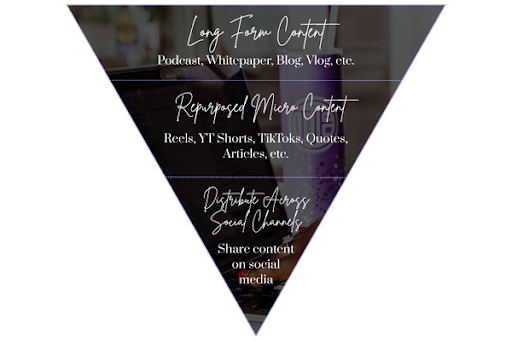
Consistency matters more than volume. Repurposing a single, longer piece of content, such as an annual report or a recorded event, into several shorter posts across platforms allows you to show up regularly without having to create something new every day. This works especially well with a simple content pyramid: start with one long-form piece, break it into a handful of medium posts, and break those into several short social captions or clips. Scheduling tools make this manageable for a small team too: LinkedIn allows free native scheduling, and tools like Hootsuite or Buffer can handle the rest for a modest monthly cost, often just a few dollars for a small number of profiles.
This Week's Challenge
Gather one real story from your organization's work this week, whether that's a value, an impact update, a behind-the-scenes moment, or an invitation to get involved, and post it with intention rather than just to fill the calendar. That single story, told well, will do more for donor engagement than a month of posts optimized purely for likes.
If you'd like help building a social media strategy that goes beyond the likes, Tonnisha English-Amamoo and the team at TJE Communications work with nonprofits to build nonprofit content strategy that turns followers into lasting nonprofit brand loyalty.
Schedule a free strategy session to talk through what that could look like for your organization.
Tonnisha English-Amamoo is the founder of TJE Communications, where she's spent over a decade helping nonprofits build sustainable communications ecosystems that amplify their mission and story. She believes movements deserve marketing.