
From Follower to Advocate: How Nonprofits Build Brand Loyalty Through Content
They follow you on Instagram. They open your emails. They showed up at your last event.
But are they loyal?
There's a difference between someone who follows your nonprofit on social media and someone who would tell their friend, their neighbor, and their coworker about your organization unprompted. Someone who would donate again and again without being asked, volunteer without being recruited, and defend your mission when someone questions its relevance.
That person is an advocate. And building them is the real work of nonprofit communications.
Today, we’re breaking down what brand loyalty actually means for mission-driven organizations, the content strategies that create it, and how small teams can build it without burning out.
What Is Brand Loyalty (and Why It Matters for Nonprofits)?
Brand loyalty isn't a marketing buzzword; it's a feeling.
Think about why some people are "Ulta Beauty Girls" and others are "Sephora Girls." Both stores sell similar products. The difference isn't the merchandise (or even the pricing), it's the feeling you get walking in the door.
For nonprofits, brand loyalty is when your audience becomes so aligned with your mission that they become dedicated to your organization. They aren't just supporters, they're invested. And when you reach that level, fundraising stops feeling like a hard pull. People give because they already feel like they're a part of what you're building.
That long-term support looks like:
Monthly donors who give recurring gifts, every month, without needing a campaign to nudge them
Funders who renew multi-year grants because they believe in your trajectory
Volunteers who show up consistently and recruit others
Community partners who call you because your reputation precedes you and the organization
The goal of your content isn't just engagement. It's building community.
4 Content Pillars That Build Brand Loyalty
You don't need to produce every type of content to build loyalty. But understanding these four pillars gives you a strategic foundation to build on.
1. Value-Based Storytelling
This is content that speaks to what your audience believes in: your organization's mission, vision, and the systems you're working to change.
Value-based storytelling isn't about announcing what you do. It's about showing why it matters and who it connects to. A single photo of five community organizations gathered together at a local organizing revival, without a single "donate now" in sight, can communicate your values more powerfully than any fundraising ask.
Ask yourself: What does our community believe? What are we fighting for or against? What does our presence in this city, this neighborhood, this movement mean?
Tell that story!
2. Impact Updates
Your supporters made a bet on you when they gave their time or money. Impact updates are how you honor that bet.
Sharing progress on your current programs, initiatives, and milestones keeps your community connected to the outcomes their support is making possible. A photo of a county commissioner visiting a program your donors helped fund, with a caption that says "here's what your support made possible,” does more to build long-term loyalty than a year-end thank-you email.
Don't wait for the annual report to show people what their support is doing. Share it in real time, across your platforms, consistently.
3. Behind-the-Scenes and People-Centered Content
For small and growing nonprofits, especially: people want to see you.
Stock photos don't build trust. The faces of your team, your volunteers, your staff, your community — those build trust. This type of content brings the human element to your organization and makes your followers feel like part of the process, even if they haven't directly participated yet.
A 15-second video of a volunteer sharing why they choose to show up every Friday? That's more powerful than any graphic you could design. And it doesn't cost much to produce.
4. Calls to Belonging — Not Just Action
We're all used to the big campaign pushes: Giving Tuesday, year-end fundraising, the spring gala, etc. Those are important. But if loyalty is built only around those moments, you'll always be starting from scratch.
Instead, think about how you invite people into your movement — not just the moments.
Update your community on ways to get involved between campaigns. Ask volunteers to become donors. Ask donors to become volunteers. Show people the next step in the relationship and ask them to take it. Sometimes people don't deepen their involvement simply because no one asked them how they can.
What to Post (and When)
The most common marketing block I see amongst nonprofit organizations is knowing what to say and when.
Here's the reframe: everything can be content, but not everything should be.
Your job is to decide which content will further your organization's mission. That might be a board meeting recap. A staff member's story. A case study. A behind-the-scenes video from a community event. The bar isn't "Is this interesting?" It's "Does this bring our audience closer to our mission?"
And while short-form video is dominating right now, (research from Sprout Social shows social media users prefer 15 to 30-second videos over static images) static posts still matter. 19% of users still engage with them. Don't abandon what's working in favor of what's trending.
The key is authenticity. A simple iPhone video, filmed on-site and posted without editing, can outperform a polished graphic if it's real. People can feel the difference.
Measuring What Actually Matters
Here's a truth most social media dashboards won't tell you: likes are not loyalty metrics.
Your board doesn't care about likes. Your funders don't care about impressions. What they care about is evidence that your communications are building a sustainable base of support.
Vanity metrics (not what you're after):
Likes
Impressions (one person can account for 10 impressions in a single scroll)
Follower count
Loyalty metrics (what you want to track):
Repeat engagers — the people who always comment, always share, always save
Video completion rates — are people watching all the way through?
Email open rates over time — do the same people keep opening?
Conversion to action — did a follower become a volunteer? Did an email subscriber become a monthly donor?
When it's time to report to your board or funders, share the stories that live inside the data. A screenshot of a donor who replied to your email saying, "I just became a monthly donor because of this story," is worth more than any bar chart. Those qualitative moments — testimonials, email responses, comments, shares — are the proof that your communications are working.
Practical Tips for Small Teams
The "dream team" marketing model includes a strategist, designer, videographer, photographer, community manager, and more. Most nonprofits don't have that And honestly, even most small business don’t (including myself). And that's okay.
Here's what actually works for small or one-person marketing teams:
Use the content pyramid (see below). Start with one piece of long-form content — a case study, a blog post, a testimonial interview — and break it down into smaller pieces. One video becomes a caption, a quote graphic, an email excerpt, and a story. Stop starting from scratch every time.
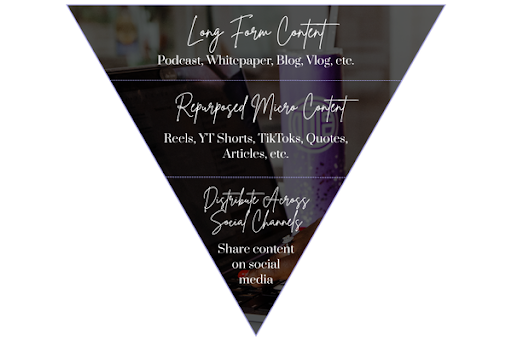
Build a content calendar. This doesn't need to be fancy. A Google Sheet or even a printed calendar will do. The goal is to plan your content in advance so you're not deciding what to post at 8 a.m. the morning you're supposed to post it. Even a two-week rolling calendar makes a significant difference.
Find a second set of eyes. Even if marketing isn't their role, someone in your organization should review content before it goes out — checking dates, catching typos, and making sure the CTA is clear. Give them a deadline. A small error doesn't have to be a crisis, but a second reader helps you avoid preventable mistakes.
Schedule everything you can. Once content is approved, schedule it. Don't hold it in a draft folder. Tools like Meta Business Suite (free for Facebook and Instagram), LinkedIn's native scheduler (free), and Buffer (around $8/month) can schedule and post your content automatically. Your future self will thank you!
Ask about nonprofit pricing. Canva offers free Pro accounts to nonprofits with a 501(c) (3) designation as well as many other tools — scheduling platforms, email service providers, and more. Always ask before you pay full price.
Your Next Step
Brand loyalty doesn't happen from one post. It's built over time, through content that consistently says: we see you, we're doing the work, and you're a part of this.
Start small. This week, challenge yourself to plan two weeks of content — not 14 posts, but two posts a week, eight posts total. Think about what's already happening in your organization that you can capture. An event. A staff milestone. A supporter story. A program update.
The content is already there. You just need a system to share it.
Tonnisha English-Amamoo is the Founder & CMO of TJE Communications, a boutique communications consultancy that helps nonprofit and mission-driven organizations tell their story and build lasting community support. Ready to turn your followers into advocates?